"Youth is like spring, an over-praised season more remarkable for biting winds than genial breezes.
Autumn is the mellower season, and what we lose in flowers we more than gain in fruits."
- Samuel Butler
UNL Gardens: A Beautiful Way to Learn!
We are dedicated to the proposition that the living horticultural resources of the University of Nebraska – Lincoln's East Campus are not only places to enjoy aesthetically, they are an invaluable educational tool, a place to reflect on life; they are an often overlooked jewel in the crown of Lincoln's greenspaces.
UNL Gardens is supported by the IANR Vice Chancellor's office with help from the Friends of Maxwell Arboretum and is housed in the Community Forestry and Sustainable Landscape Program of the NFS. continue reading . . .
See you in the gardens,
Emily Levine
University of Nebraska – Lincoln
New Postings
→ UPDATED BLOOM TIME CHART for Maxwell Arboretum
→ NEW MAP OF MAPLES OF MAXWELL ARBORETUM!
→ NEW OAK PAGES have been posted! Photos, information, maps for every oak species, cultivar, and hybrid in Maxwell Arboretum, as well as a keyed map to other oaks of interest on East Campus.
→ Check out the new Vine Arbor pages! Learn about vines and get a map to the collection, plus information on each specimen, and a quick guide: https://unlgardens.unl.edu/vinearbor
Be sure to check out our new VIBURNUM PAGES for genus introduction, collection maps, resources , and individual species and cultivar information:
http://unlgardens.unl.edu/viburnumsNEW BROCHURE! "Spruces and other Conifers of the Yeutter Garden." Information on 13 great species.
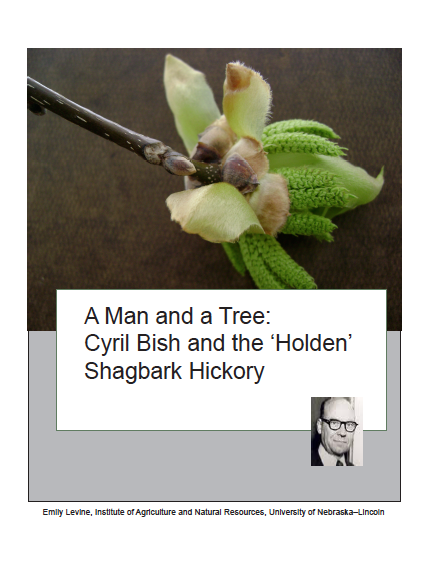
"A Man and a Tree: Cyril Bish and the 'Holden' Shagbark Hickory" (PDF)
NEW 2005-2015 MAXWELL ARBORETUM
BLOOM TIME CHART AVAILABLE
- UPDATED Maples of Maxwell Arboretum map!
- Deciduous Conifers of Maxwell Arboretum
- The Bibliographic Database of Historic Great Plains Plants Resources has been updated. It now contains eighty entries---but has a long way to go so check back in the future. (PDF 1.8MB)
Those of you who have spent much time on this web site are probably aware of my interest in and admiration for the literary naturalist Donald Culross Peattie (1898-1964). Peattie was a Harvard-trained botanist, remembered today--if at all--for his monumental two-volume A Natural History of Trees . If one reads these books, one will learn that Peattie's beauty lies not just in his botany but in his lyrical philosophical prose. Never before or since has a tree handbook contained such magnificent writing.
In a case of the exception proving the rule, the recent republication of A Natural History of Trees (as a travesty of a butchered one-volume work), only shows how completely we have forgotten this once esteemed master of what we now call "nature writing."
"I think we owe the man and his words some time and consideration...to amend for our great error in forgetting him" ("Donald Culross Peattie: A Friend in the Green Dusk," Columbanus Bestrode [see James Joyce, Ulysses ]).
One of Peattie's most profound works and perhaps the one that first gained him a reputation is An Almanac for Moderns (1935). This odd little book contains 352 page-length or less writings for each day of the year. Peattie takes us through an entire year, beginning on the vernal equinox--March 21st--and circling all the way around to that same date. Given his profound mind, this book does not simply record the yearly cycle of the natural world, although this he does with sketches of surprising detail and sensitivity. On the contrary: Peattie uses the Almanac to open the whole world to us.
An Almanac For Moderns quote archive2021
The Nebraska Statewide Arboretum's GreatPlants® for the Great Plains program ("one of five awards worth watching"—Garden Design Magazine) has announced their choices for. Here's the full list and some East Campus locations:
2021 Plants and where to find them on East CampusTree of the Year: Celtis occidentalis Common Hackberry
just east of the Gazebo, Maxwell Arboretum
Conifer of the Year: Pinus strobus Eastern White Pine
south side of the Prairie, Maxwell Arboretum
Shrub of the Year: Viburnum sargentii ‘Chiquita’, ‘Chiquita’ Sargent Viburnum. NOT on campus.
Perennial of the Year: Asclepias incarnata, Rosy or Swamp Milkweed
Rain Chain Garden, near Backyard Farmer Garden
Grass/Sedge of the Year: Miscanthus sinensis ‘Morning Light’, ‘Morning Light’ Maiden Grass
Yeutter Garden berm, Maxwell Arboretum; Evasco Garden, east of Keim Hall
Want to see other GreatPlants® ?
Click here to view a map of the 2012 GreatPlants® in Maxwell Arboretum
Click here to view a map of the 2010 Great Plants® in Maxwell Arboretum
New Prunus besseyi (Western Sandcherry) planted June 26th, the day that Charles Bessey was inducted into the Nebraska Hall of Fame. click here for more info
and click here to view historical documentation related to Charles E. Bessey and the Western Sand Cherry
IN MEMORIAM
We lost one of the oldest trees on campus in August 2009 when the so-called "Russian Oak" across from the Dairy Store was taken down. Age, road construction, and a lightning strike last year, all contributed to the tree's decline. The tree is actually an English Oak that was planted from acorns brought from Russia in 1905. University horticulturist R.A. Emerson is credited with planting this tree which stood as a welcoming beacon at one of the campus's south entrances.
_____________
UNL GARDENS_
This website is no longer mantained but you'll still find lots of useful information here!
_____________________
We offer these
→ SELF-GUIDED TOURS! ←
HAVE FUN!
NEW! SELF-GUIDED TOUR OF "OTHER OAKS OF INTEREST ON EAST CAMPUS":
Find us on Facebook and click "Like" to get updates on Maxwell Arboretum tours, what's happening in the gardens, campus landscape history, and lots more!

****Want to make sure that you see ALL OF THE POSTS from UNL Gardens?: ****
Facebook uses a complex algorithm to pick and choose what they let you see in your Facebook feed. (They also try to get page administrators to pay to guarantee that everyone who has "liked" our pages gets to see all of the posts.) Here are a few things you can do to make sure you don't miss any posts:
- Go to the UNL Gardens Facebook page . Find the "Like/Liked" button near the top and hover your cursor over it. In the drop down menu click Get Notifications. Theoretically, you should then get a notification in your Facebook menu bar at the little globe icon that you can click on.
- Simply visit the UNL Gardens page often to see the posts. Just enter UNL Gardens in the Facebook search box.
- The Facebook algorithm responds to how much you interact with a page. If you "Like" posts or images often, or respond to images by commenting, you are more likely to receive more posts in your feed.
(If you've "liked" pages in the past and wonder why you never see posts from them anymore, this is why.)
What's Happening
JOIN THE FRIENDS OF MAXWELL ARBORETUM!
Read about Maxwell Arboretum's fascinating Deciduous Conifers : Larix decidua (European Larch), Taxodium distichum (Baldcypress), and Metasequoia glyptostroboides (Dawn Redwood)